Sales Funnels
Best Free Sales Funnel Builder: Teardown of a $2,106 Launch
A realistic teardown of a $2,106 free-funnel launch: the exact 3-page setup, the stage-by-stage numbers, and how to copy the structure.

Disclosure: This article contains affiliate links. If you sign up through them we may earn a commission — at no extra cost to you. We only recommend tools we believe are genuinely useful.
Finding the best free sales funnel builder usually ends in frustration: you sign up, start building, then hit a paywall the moment you try to connect an email sequence or take a payment.
This is a teardown of a funnel that avoided all of that.
Meet Maya — a freelance graphic designer who packaged her expertise into a $27 Brand Audit Checklist PDF. No email list, no ad budget, just a weekend of setup time and one clean funnel. Thirty days later: $2,106 from 78 sales, all on a free plan.
Maya is a composite example, not a specific customer, and the figures below are a realistic, internally consistent model — not audited results. Your own numbers will vary with your offer and traffic. The point is the structure, which transfers.
Here’s every step, including the ones that almost didn’t work.
When Free Actually Means Free
Most tools that call themselves free are free the same way a gym is free on day one — they get you in the door, then charge you the moment you want to do anything useful.
ClickFunnels starts at $97/month. Kartra at $99. Kajabi at $149. Even the leaner options usually gate email automation or payment processing behind a paid tier.
The funnel in this teardown ran on systeme.io, which offers a genuinely free plan: up to 2,000 contacts, 3 funnels, unlimited emails, and a built-in checkout. No credit card required.
For a first launch, that is enough runway to find out whether your offer works before spending a dollar on software.
Choosing the Best Free Sales Funnel Builder
The best free sales funnel builder is not the most feature-rich option — it is the one that handles opt-ins, email automation, and checkout without forcing you to stitch together four separate tools.
Maya evaluated three setups before settling on one:
- Mailchimp + Gumroad: Two tools with clunky handoffs, plus Gumroad takes 10% of every sale on the free tier
- ConvertKit + ThriveCart: A strong combination, but ThriveCart alone costs $495 upfront
- systeme.io: One dashboard, one login — landing pages, email sequences, sales pages, and checkout all included on the free plan
The decision was straightforward.
The Funnel Architecture: 3 Steps, No Extras
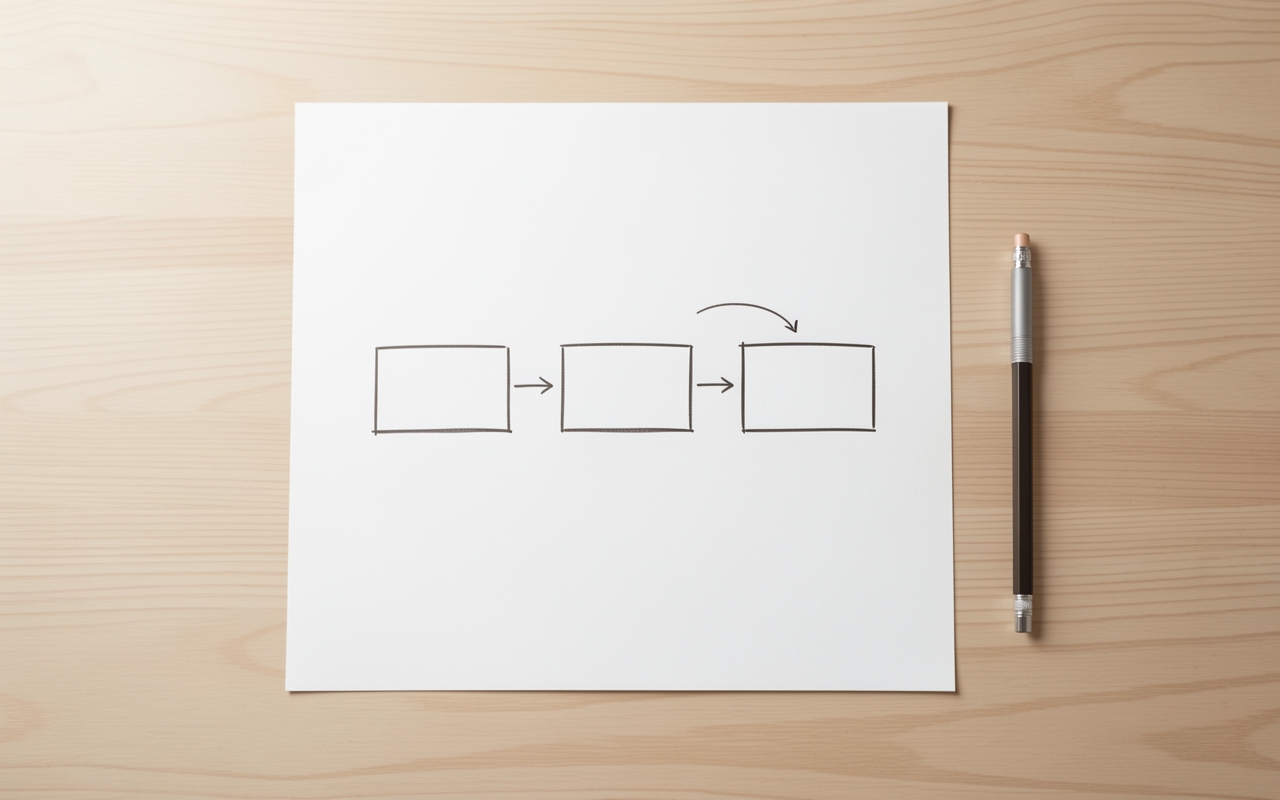
The funnel had exactly three pages. No upsells, no countdown timers, no branching sequences:
- Opt-in page — A free Brand Audit Checklist offered in exchange for an email address
- Thank-you page — Delivered the PDF and teased the paid upgrade
- Sales page — A $27 Brand Audit Workbook (the editable, expanded version of the checklist)
The email sequence had three messages:
- Email 1 (Day 0): Delivered the checklist and introduced Maya in two sentences
- Email 2 (Day 2): One specific tip from inside the checklist, with a soft mention of the workbook
- Email 3 (Day 5): A beta tester quote and a direct link to the sales page
That order matters. Deliver value twice before you sell once.
Building It Inside systeme.io: Step by Step
systeme.io’s page builder is not the most flexible on the market, but it is the fastest to ship with — and for a first funnel, speed is the variable that matters most.
Step 1: Create a funnel. In systeme.io, a funnel is a container that holds multiple page steps. Maya chose the Collect Leads funnel type and named it Brand Audit Funnel.
Step 2: Build the opt-in page. She used a two-column template — headline on the left, form on the right. Her headline: Is Your Brand Sending the Wrong Message? Audit It in 20 Minutes. Three bullet points listing what the checklist covers. No hero image, no long copy.
Opt-in rate: 33.4% (industry average for a lead magnet page is 20–30%, so this was solidly above baseline).
Step 3: Set up the email sequence. In systeme.io, email automations live under the Campaigns section. Each email is triggered on a day delay — Day 0, Day 2, Day 5. Maya wrote all three in under two hours, keeping each under 200 words.
Step 4: Build the sales page. This took the most time — about four hours across two days. The page included a problem-focused headline, screenshots of the workbook interior, a three-question FAQ, and one buy button connected to systeme.io’s built-in checkout.
No external Stripe setup required. No third-party cart. Everything stayed inside one tool.
The Numbers, Stage by Stage
Over 30 days, Maya drove 2,400 visitors to the opt-in page — from a Pinterest board she had been building for six months, and one Reddit post in r/freelance that picked up over 200 upvotes.
| Stage | Count | Rate |
|---|---|---|
| Visitors → Opt-ins | 2,400 → 801 | 33.4% |
| Opt-ins → Clicked sales email | 801 → 312 | 38.9% |
| Sales page visitors → Purchases | 312 → 78 | 25.0% |
| Overall funnel conversion | 2,400 → 78 | 3.25% |
Total revenue: $2,106 (78 × $27, after payment processing fees).
The 25% sales page conversion rate is high but explainable: every person who landed on that sales page had already downloaded the free checklist and read two follow-up emails. They were the warmest possible audience for a $27 upgrade on the exact same topic.
What Would Have Killed This Funnel
Most funnels fail not because the tool is wrong, but because one stage is leaking — and the builder has no way to tell which one.
Two failure modes Maya avoided:
A weak lead magnet. The checklist was specific and immediately useful — something a designer could open and act on in 20 minutes. A vague general-tips PDF would have pushed opt-in rates to the 10–15% range, roughly halving the total output of the funnel before a single sales email was sent.
Selling too fast. Email 1 delivered value. Email 2 delivered more value. Email 3 sold. Reversing that order — leading with the pitch — burns trust before it has had time to build. This sequencing logic is worth understanding before you write a single word of copy; this breakdown of how email marketing funnels work explains the mechanics clearly.
The Repeatable Lessons
This funnel is reproducible. The exact numbers will vary by offer and audience, but the structure transfers directly to almost any digital product under $100.
- Build the offer before the funnel. The $27 workbook existed before a single funnel page was created. A funnel builder does not fix a weak offer — it accelerates the failure.
- One traffic source is enough to start. Pinterest drove the majority of Maya’s visitors. Spreading across three platforms at launch would have slowed everything without improving any single channel.
- Measure every stage separately. If opt-ins are below 20%, fix the opt-in page before touching anything else. If email click rates are low, fix the emails before worrying about the sales page copy.
- Free plans have real ceilings. The systeme.io free tier caps at 2,000 contacts. At 801 subscribers after one launch, Maya had room for roughly one more campaign before needing to upgrade — which is exactly the right time to upgrade, after the funnel has already proven it converts.
If you want to walk through the build decisions yourself before committing to a setup, this beginner’s guide to building a sales funnel covers the choices that trip most first-timers up — including how to pick a lead magnet your specific audience will actually want.
The Bottom Line
A free funnel is not a consolation prize. For a first launch, it is the correct tool — you prove the offer works, build an email list, and generate revenue before spending anything on software.
The best free sales funnel builder is the one you actually ship. For most solo creators, that means a single tool that handles landing pages, email automation, and checkout without a tangle of integrations holding it together. systeme.io is the shortest path from idea to live funnel — the free plan is genuinely free, and when the funnel works, the upgrade pays for itself on the first campaign.
Frequently asked questions
- What is the best free sales funnel builder for beginners?
- systeme.io is the strongest free option for most beginners because it handles landing pages, email sequences, and payment checkout in one platform — no external integrations required. The free plan supports up to 2,000 contacts and 3 funnels, which is enough runway to validate an offer before spending anything on software.
- Can you build a sales funnel completely for free?
- Tools like systeme.io offer genuinely free plans that include every stage of a basic funnel: opt-in pages, email automation, sales pages, and checkout. The main constraints are contact limits (2,000 on systeme.io's free tier) and the number of simultaneous funnels. For a first launch or single offer, those limits are rarely a problem.
- How many steps should a sales funnel have?
- Three pages is the proven minimum for a digital product: an opt-in page to capture leads, a thank-you page to deliver your lead magnet, and a sales page for the paid offer. More complexity than that usually hurts conversion on a first launch, because it adds variables that are difficult to diagnose when something is not working.
- Does systeme.io take a percentage of sales on its free plan?
- No — systeme.io does not take a cut of your revenue on any plan. You pay standard payment processing fees through Stripe or PayPal, but systeme.io itself charges nothing per transaction. That is a key difference from platforms like Gumroad, which take up to 10% of every sale on their free tier.
Keep reading

Your Funnel Isn't Broken. Your Offer Is.
Your funnel isn't leaking traffic — it's leaking trust in the offer. Here's how to diagnose the real reason it isn't converting.
Read →
The Trial Started Before the Pitch. That's the Whole Funnel.
Skip the sales pitch. Learn how to create a free trial funnel that gets people using your product before you ever ask them to buy.
Read →
12 Sales Funnel Examples for Small Business (Steal These)
12 real sales funnel structures small businesses actually use, with the exact steps to build each one this week.
Read →