Sales Funnels
How to Build a Sales Funnel for Beginners (You're Overthinking It)
Most funnel advice is built for experts, not beginners. Here's the 3-page funnel that actually works — and why complexity is killing your launch.

Disclosure: This article contains affiliate links. If you sign up through them we may earn a commission — at no extra cost to you. We only recommend tools we believe are genuinely useful.
You’ve been studying funnels for three weeks and you still haven’t launched one. That’s not a motivation problem — that’s a complexity problem, and the advice you’ve been following caused it.
Search “how to build a sales funnel for beginners” and you’ll find step-by-step guides covering lead magnets, tripwire offers, upsell sequences, retargeting pixels, and webinar replay pages. It reads like a blueprint for a serious business — because it is. For someone with an existing audience, a validated offer, and steady traffic already coming in, that architecture makes sense. For a beginner? It’s paralyzing.
The conventional funnel wisdom isn’t wrong. It’s just premature.
Why Most Funnel Advice Is Built for Experts, Not Beginners
The standard funnel framework exists for genuinely good reasons. Multi-stage funnels — lead magnet, email nurture sequence, low-ticket tripwire, core offer, upsell — work. Each layer exists because someone collected data and found it increased conversions. A low-friction lead magnet lowers the barrier to entry. A tripwire filters for buyers. An upsell lifts average order value. There’s nothing cynical about any of it.
The problem is that this advice assumes you already have something to optimize. It’s written for marketers who have steady traffic and want to squeeze more performance from it. Teaching it to a beginner is like handing a new driver a book on pit crew strategy before they’ve started the engine.
What Overbuilding a Funnel Actually Costs You
Complexity kills momentum before your first launch. Consider the beginner who builds a seven-step funnel — lead magnet, 10-email nurture sequence, two upsells, an order bump, and a cross-sell on the thank-you page. They spend six weeks on it. Then they launch to 40 visitors and make no sales.
Now they have no idea which of the seven pieces failed.
The funnel isn’t broken because it’s complicated. It’s broken because it was optimized before it was validated. With 40 visitors and zero conversions, the data is statistically meaningless. But with a 3-page funnel, you’d have isolated the only question that matters right now — does the offer convert at all? — and had a real answer in a week.
Expert funnels aren’t wrong. They’re designed for a different stage.
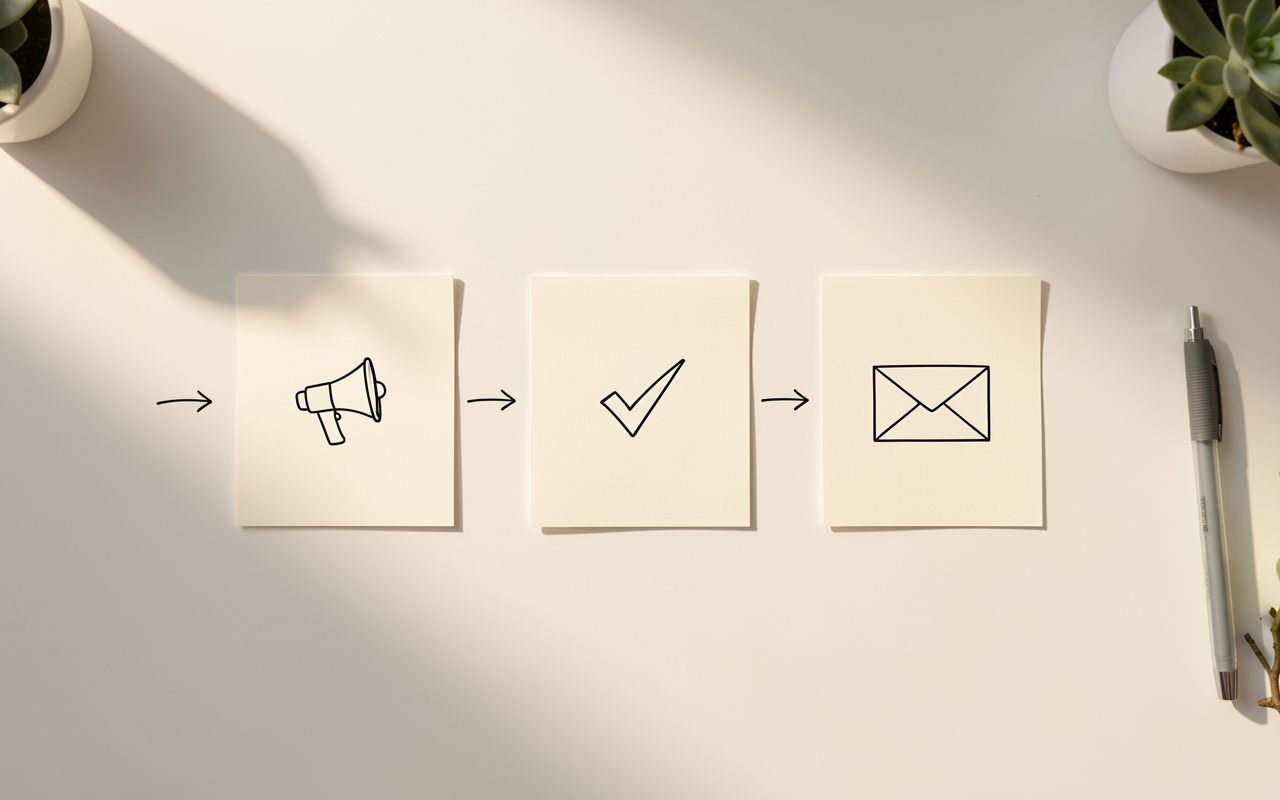
How to Build a Sales Funnel for Beginners: The 3-Page Method
A beginner funnel doesn’t need to be sophisticated. It needs to be live. Here’s the full structure:
- A landing page — one clear promise, one call to action (sign up or buy). No navigation bar. Every link points forward.
- A delivery or thank-you page — confirms the action and hands over what you promised. Keep it short.
- One follow-up email — not a sequence, just one. Thank them, deliver immediate value, and make a single clear ask.
That is a complete, functional sales funnel. It captures attention, converts action, delivers value, and follows up. Everything else — sequences, upsells, retargeting — is what you add after you confirm this version converts.
The Landing Page
One headline that names a specific outcome. Two or three proof points. A button or a form. Nothing else. The purpose of this page is to do one thing: move the visitor to the next step. Every element that doesn’t serve that purpose gets cut. No navigation menu — you’re building a funnel, not a website.
The Delivery Page
If you’re collecting emails, deliver the lead magnet here and set expectations for what comes next. If you’re selling something, this is the order confirmation page. Its job is to close the loop and build immediate trust — not to sell more, at least not yet.
The Follow-Up Email
One email. Sent the same day or the next morning. Thank them, give them something immediately useful, and point them to one thing — a post, a short video, your core offer. You can build the rest of the sequence after you’ve confirmed the funnel is actually converting real people.
Build It in an Afternoon With the Right Tool
Your tools can either accelerate this or become another obstacle. Most funnel tutorials quietly double as product pitches for platforms that are expensive, technically demanding, or require connecting four different services before anything works.
Systeme.io is the exception. Landing pages, email marketing, and basic automation all in one place — with a genuinely free plan that covers everything a beginner needs. No trial clock ticking. No credit card required to start. One login for your whole funnel.
If you want to see what building a first funnel actually looks like in practice — including the real decisions, the unexpected friction, and the things no tutorial warns you about — this honest walkthrough of building a first funnel from scratch is worth reading before you start.
Stop Optimizing a Funnel That Isn’t Live Yet
The most common beginner mistake is refining something nobody has seen. Rewriting your headline for the fifth time before a single visitor has read it. Split-testing your button color with 30 visitors. Rebuilding your email sequence based on gut feel instead of open rate data.
That’s procrastination with productive aesthetics. The live version of your funnel — even if the headline isn’t quite right and the email is rough — is worth more than the polished version sitting in your drafts folder.
A funnel that converts at 3% and is live beats a funnel that would convert at 8% and doesn’t exist yet.
Launch the imperfect version. Real traffic will teach you more in one week than another month of refinement ever could.
What Comes After Your First Funnel
Once you have a live funnel and real numbers — even modest ones, even a 2% conversion rate — now you have something worth building on. Now you can ask specific questions: Where are people dropping off? What are buyers emailing you about? What do they do after they purchase?
That’s when you add pages. That’s when you write the email sequence, build the upsell, and think about a lead magnet upgrade. Complexity in a funnel is earned by data, not assumed at the start.
When you’re ready to think about the email side more systematically — how to turn subscribers into buyers over time — this breakdown of email marketing funnels covers the next layer well, once your core funnel is already doing its job.
Build the simple thing first. Build it live. Then build the rest.
Frequently asked questions
- What is the difference between a sales funnel and a website?
- A website is a multi-page destination where visitors explore on their own terms. A sales funnel is a linear sequence designed to move someone toward one specific action — a signup or a purchase — with no distractions. For beginners trying to sell something or build a list, a simple funnel almost always outperforms a full website because it keeps visitors focused on a single outcome.
- How long does it take to build a sales funnel for the first time?
- A basic 3-page funnel — landing page, thank-you page, and one email — can be built in three to four hours using an all-in-one tool like Systeme.io. Most of that time goes into writing copy, not configuring software. The technical setup itself takes under an hour once you know what you want to say.
- Do I need an email list before I can build a sales funnel?
- You don't need an existing email list to build a sales funnel — the funnel is how you build one. Your landing page captures emails, your delivery page confirms the subscription, and your first email starts the relationship. The funnel creates the list from scratch, one subscriber at a time.
- What is the best free tool to build a sales funnel as a beginner?
- Systeme.io is the most beginner-friendly option available right now. It combines landing pages, email automation, and basic sales capabilities in one genuinely free plan — no credit card required to start. It removes the need to stitch together multiple tools while you're still learning the fundamentals.
Keep reading

How to Get Your First Online Sale (When Nobody's Buying)
Zero sales isn't a marketing problem — it's usually one of three fixable things. Here's how to diagnose it and get your first one.
Read →
Your Funnel Isn't Broken. Your Offer Is.
Your funnel isn't leaking traffic — it's leaking trust in the offer. Here's how to diagnose the real reason it isn't converting.
Read →
7 Passive Income Ideas for Beginners With No Money
Seven realistic passive income ideas for beginners with no money, plus the exact first step to start each one today.
Read →